Research overview
Pulsar timing searches for dark matter structure
Numerical simulations, generative signal models, and sensitivity forecasts.
Compact dark matter structures can perturb pulsar arrival times through their gravitational influence. In this study, we use direct simulations to test the statistical assumptions underlying previous sensitivity forecasts and develop signal models that describe departures from Gaussianity. We then assess the reach of future pulsar timing arrays in the presence of the stochastic gravitational-wave background.
My contribution I built the simulation code, tested the Gaussian approximation, and implemented diffusion and normalizing-flow models, including the correlated Earth-term analysis. I carried out this work with Joshua Foster and Tanner Trickle.
Read the full paper ↗Doppler and Shapiro timing signals
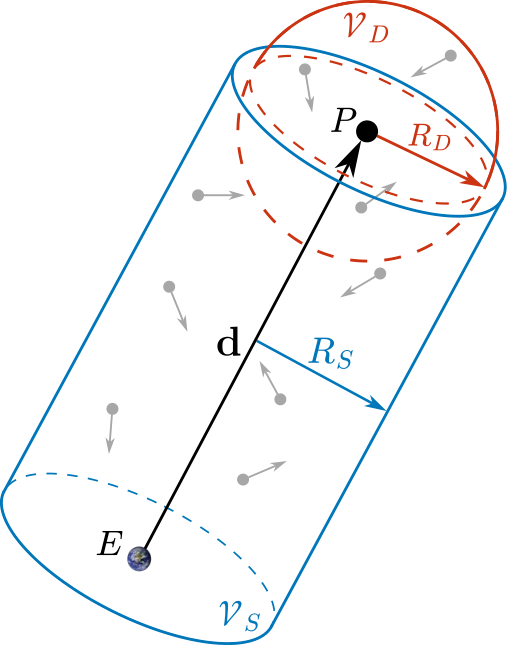
A compact object can accelerate a pulsar, shifting its pulse arrival times through the Doppler effect. It can also alter the light-travel time along the radio signal’s path through the Shapiro effect. We sample the relevant spatial distribution of objects separately for each geometry.
We evolve the simulated objects’ trajectories and calculate their timing perturbations. We then remove components absorbed by the pulsar timing model, which fits the pulsar’s phase, rotation frequency, and frequency derivative. The remaining signal determines the sensitivity of the search.
Non-Gaussian signal distributions
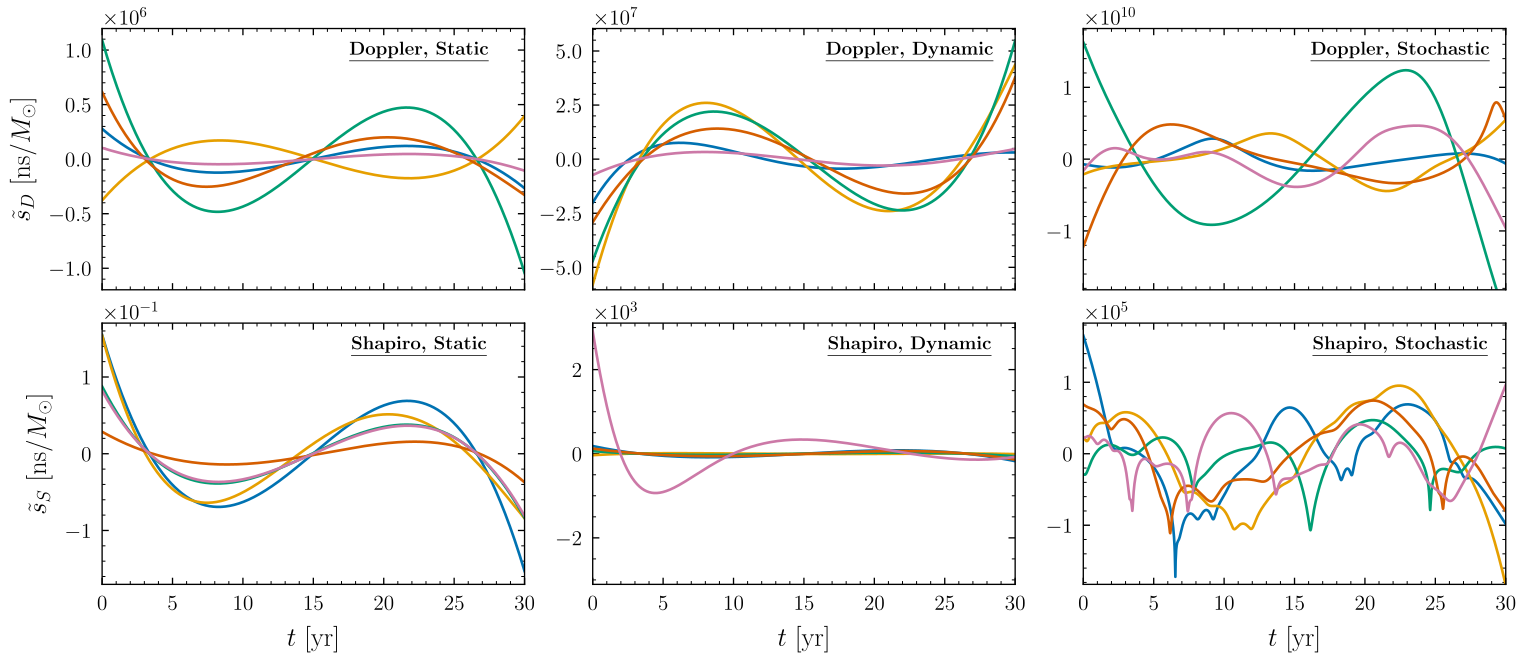
Previous forecasts treated the combined contribution of many dark matter structures as a Gaussian process. Our simulations show that substantial departures from Gaussianity can persist even for large populations. Rare, nearby encounters contribute disproportionately to the signal, so the number of objects alone does not establish the validity of the approximation.
We construct signal distributions across the static, dynamic, and stochastic regimes. This requires retaining the statistical structure relevant to inference while reducing the cost of repeatedly sampling large populations of dark matter objects.
Generative models for statistical inference
A normalizing flow models the distribution of a compressed cubic amplitude, appropriate for slowly varying signals after timing-model subtraction. We apply the same compression to the data, signal, and background. This gives a consistent likelihood for the compressed data, although it discards information in more complex signal shapes.
A diffusion model, conditioned on the number of relevant dark matter structures, generates full projected timing signals. It provides a computationally efficient sampler of their distribution without imposing a Gaussian approximation. We use these samples in the likelihood calculation, compare the methods where their assumptions overlap, and check convergence of the Monte Carlo forecasts.
- Simulate encounters
- Learn signal distributions
- Combine with background
- Forecast sensitivity
Correlated Earth-term signals
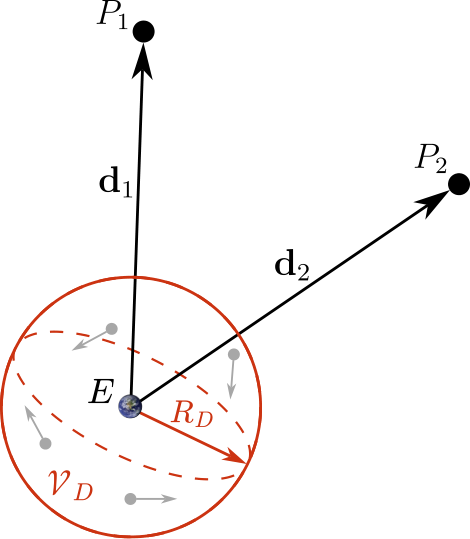
A compact object near our Solar System can perturb the arrival times from many pulsars together. This Earth term contains a shared angular pattern: each pulsar sees a different projection of the same underlying acceleration. Treating the pulsars as independent would throw away that structure.
We therefore model a three-dimensional cubic response vector with a normalizing flow and project it onto the pulsars’ directions. The background model also retains correlations between pulsars. This makes a joint search tractable while preserving the geometry that distinguishes the signal.
Sensitivity with a gravitational-wave background
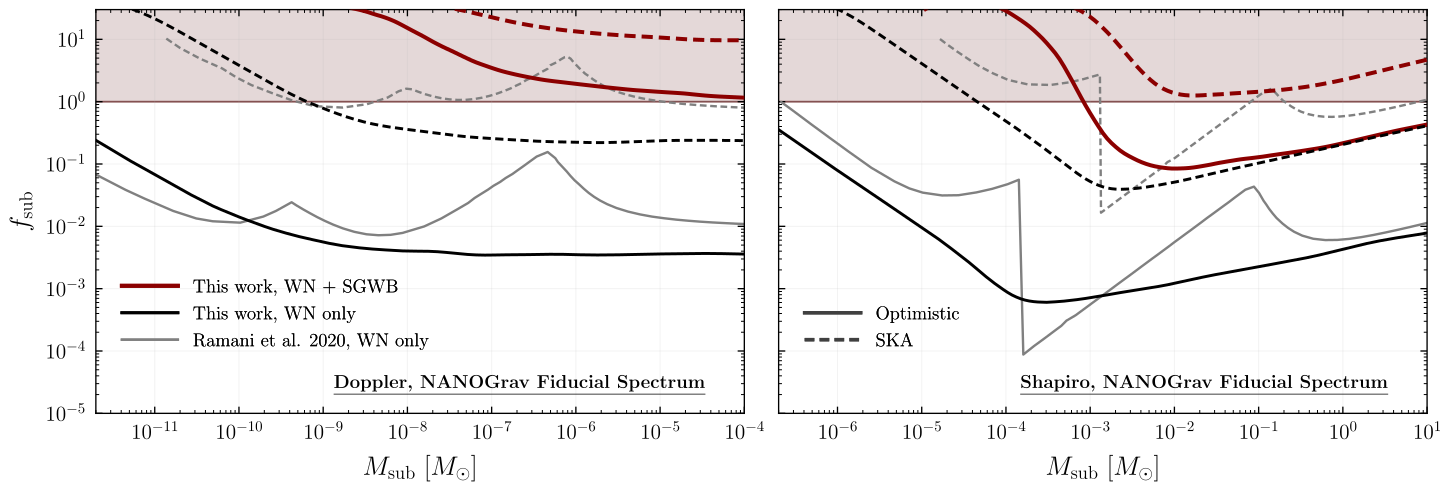
The gravitational-wave background substantially weakens the forecast reach. With the background parameters used in our fiducial study, the Doppler searches do not reach physically allowed substructure fractions in either benchmark array. The Shapiro channel remains more promising, retaining sensitivity below the full dark matter abundance in the optimistic scenario.
These are deliberately favorable forecasts for compact objects, not a detection or an analysis of measured PTA data. We omit intrinsic pulsar red noise and assume known background parameters. The diffusion calculation is validated for these noise-only projections; it is not a claim of fully calibrated inference at arbitrary signal strength.
Figures from Foster, Trickle & Vassallo, arXiv:2606.18329v2.
← Back to the paper